Disclosure: YODA COIN may earn a commission if you sign up with our referral code or link, at no extra cost to you. Read our disclaimer.
What is MEXC exchange?
A crypto exchange is a website and app where people buy, sell and trade cryptocurrencies. MEXC is a centralized exchange: a company that holds users’ coins in its own wallets and matches buyers with sellers. It says it has more than 40 million users across over 170 markets and offers over 3,000 digital assets (MEXC report, July 2026).
MEXC’s two core markets are spot and futures. Spot trading means you buy a coin at today’s price and own it outright. Futures are contracts that let you bet on a coin’s price going up or down without owning it. MEXC had nearly 2,000 spot trading pairs and over 350 derivative pairs in December 2025 (MEXC listing guide, December 2025).
A trading pair such as BTC/USDT shows the coin you buy and the coin you pay with. USDT (Tether) is a stablecoin, a coin designed to stay close to 1 US dollar. MEXC also has its own token, MX, which can pay part of your trading fees.
Who runs MEXC, and since when?
MEXC was founded in 2018 (MEXC Guardian Fund announcement, June 2025). Its September 2026 press releases name Vugar Usi as its CEO (MEXC September 2026 PoR, 15 September 2026). Its apps are published under the developer name MEXC Fintech, Inc. (MEXC app download). Its User Agreement is governed by the laws of England and Wales (MEXC User Agreement, May 2025 version).
None of the MEXC pages we checked for this guide names a license from a financial regulator. MEXC’s own Learn article says it is not authorized under MiCA, the EU’s Markets in Crypto-Assets rules. ESMA, the EU’s markets regulator, lists MEXC as non-compliant after a September 2025 decision by the Dutch regulator AFM (MEXC Learn: crypto loans, August 2026, checked 21 September 2026). So MiCA’s customer protections don’t apply, and your protection comes mainly from MEXC’s own reserves, funds and User Agreement.
How does MEXC work?
MEXC works in five stages: open an account, verify your identity, add funds, trade, and withdraw.
- Open an account. Sign up in the official app or on mexc.com with an email address or a mobile number. Google, Apple and Telegram logins also work (MEXC sign-up guide, April 2023).
- Verify your identity. KYC (“know your customer”) is the identity check exchanges run with your ID document. MEXC requires it before you can withdraw (MEXC KYC guide, checked 21 September 2026).
- Add funds. Crypto sent to MEXC over a blockchain (an on-chain deposit) arrives free (MEXC 0-fee page). You can also buy crypto on P2P, or by card or bank transfer through MEXC’s payment partners (MEXC User Agreement, May 2025 version).
- Trade. Your coins start in your Spot account. MEXC keeps separate accounts for futures, DEX+ and stocks, and you move funds between them in the app.
- Withdraw. Send crypto to an outside wallet, or to another MEXC user for free (MEXC withdrawal fees, September 2025).
Trades happen in an order book, the live list of buy and sell orders at each price. If your order waits in the book, you are a maker. If it fills straight away against an order already there, you are a taker (MEXC fee page). If you’d rather skip the order book, MEXC Convert swaps one coin for another at a fixed quoted rate (MEXC Convert announcement, September 2026).
New accounts also see the Rewards Hub, where MEXC lists its new-user tasks, explained in our guide to MEXC’s new-user tasks and referral rules.
MEXC products: what you can trade and use
MEXC offers spot and futures trading, practice and copy trading, P2P, savings, token launches, on-chain trading, US stocks and crypto loans. Here is each one and the rule to know first.
| Product | What it does | Know this first |
|---|---|---|
| Spot | Buy and sell coins outright | Taker orders pay a fee; see the fees table |
| Convert | Swap one coin for another at a fixed quoted rate | No order book needed |
| Futures | Bet on price up or down, with leverage up to 500x | High risk: you can lose your whole margin |
| Demo trading | Practice futures with demo funds and live market data | No real profit or loss |
| Copy trading | Automatically copy another trader’s futures positions | Same futures risk; MEXC shows 7-day and 180-day results |
| P2P | Buy or sell crypto directly with other users | KYC required; MEXC holds the seller’s coins in escrow |
| Earn | Flexible savings, fixed savings and on-chain earning | KYC required; fixed savings are locked for their term, and early redemption, where offered, costs pending interest |
| Launchpool | Stake MX, USDT or project tokens to earn new tokens | KYC required; restricted regions excluded |
| DEX+ | Trade on-chain tokens from your MEXC account | No wallet of your own needed; funded from Spot |
| RealStocks | Buy real US stocks with USDT through a US broker | Eligible users only |
| Loans | Borrow USDT or USDC (another US-dollar stablecoin) against crypto you hold | Primary KYC and a 100 USDT minimum loan |
Sources: MEXC leverage guide (September 2025), demo trading (July 2026), copy trading (July 2025) and P2P (May 2026). Also Earn (July 2026), Launchpool (January 2026) and crypto loans (August 2026).
A few terms from the table. Escrow means MEXC locks the seller’s coins until the buyer’s payment is confirmed. To stake is to lock tokens for a while to earn rewards.
Futures, copy trading and demo trading
Futures carry the most risk on MEXC. Margin is the money you put up to back a position. Leverage means trading with borrowed money: at 10x, a 1% price move changes your margin by about 10%. Liquidation is when MEXC closes your position because your margin has run too low, and that margin is gone. A long bets the price goes up, and a short bets it goes down.
Copy trading doesn’t remove this risk, because you copy someone else’s losses too. To learn futures, practice in demo trading first: it mirrors real conditions, with no real profit or loss.
DEX+ and RealStocks
DEX+ connects your MEXC account to several decentralized exchanges (DEXs), where tokens trade directly on a blockchain. You don’t need your own Web3 wallet or its seed phrase, the backup words that protect it (MEXC DEX+ announcement, March 2025). Only risk money you can afford to lose.
RealStocks lets eligible users buy real US shares, held in their own name, using USDT (What is RealStocks?, June 2026). MEXC says it runs through Atomic Vaults Securities, a broker regulated by FINRA, the US securities industry regulator. Stock futures go up to 200x leverage (MEXC stock products guide, August 2026).
What is the MX token?
MX is MEXC’s own token, first launched in 2018 to pay trading fees at a discount (MX Token 2.0 announcement, December 2021). Paying fees with MX now cuts them by 20% on spot and USDT-M futures (futures settled in USDT) (MEXC fee guide, checked 21 September 2026).
A second perk, the MX Holder Discount of 50% for holding 500 MX or more, has been suspended since 9 February 2026 (MEXC announcement, February 2026). So don’t buy MX only for a fee perk that MEXC can change.
MEXC fees: what you pay to trade, deposit and withdraw
MEXC’s standard trading fees are 0% maker and 0.05% taker on spot, and 0.01% maker and 0.04% taker on futures (MEXC fee guide, February 2026, checked 21 September 2026). So the “0-fee” label on MEXC’s homepage covers only some trades.
| Fee | Standard rate | Notes |
|---|---|---|
| Spot maker / taker | 0% / 0.05% | 0% / 0.04% if you pay with MX |
| Futures maker / taker | 0.01% / 0.04% | 0.008% / 0.032% if you pay with MX |
| Futures on 0-fee pairs | 0% / 0% | Selected pairs only; API (automated trading), institutional, market-maker and project-team accounts excluded |
| Convert | No trading fee | You see the rate before you confirm |
| P2P | No platform fee | On supported transactions |
| Crypto deposit | Free | The sending wallet or exchange may still charge |
| Crypto withdrawal | Network fee | Set by the blockchain; free to another MEXC user |
| Funding fee | Varies | Paid at set times between long and short traders; MEXC takes no share |
| Liquidation | Fee taken from your margin | 0-fee pairs don’t cover it, and you lose the position’s margin |
Sources: MEXC 0-fee page, Convert announcement (September 2026), P2P guide (May 2026), withdrawal fees (September 2025) and futures FAQ. Rates can vary with promotions or your region, and the MX discount doesn’t apply to every pair or account (MEXC fee page).
Withdrawal fees depend on the network, the blockchain a coin travels on. MEXC suggests cheaper networks, such as TRC-20 (Tron) or Solana for USDT instead of ERC-20, if the receiving wallet supports them.
Is MEXC safe?
MEXC publishes monthly Proof of Reserves, and its September 2026 report was audited by Hacken, a blockchain security firm. It also runs two protection funds, but it has no EU MiCA license. Its funds are its own promises, not government deposit insurance.
Proof of Reserves: does MEXC hold users’ coins?
Proof of Reserves is a report showing an exchange holds at least as much of each coin as its users deposited. The reserve ratio compares the two: 119% means 119 USDT held for every 100 USDT owed to users. MEXC started publishing it on 22 February 2023 for BTC, ETH, USDT and USDC (MEXC PoR launch).
The September report used a 10 September snapshot, and all four ratios were above 100%. MEXC’s CEO says a new report comes out every month (MEXC September 2026 PoR, 15 September 2026, checked 21 September 2026).
| Asset | Reported July 2026 | Snapshot 10 September 2026 |
|---|---|---|
| BTC | 269.35% | 297% |
| ETH | 118.14% | 111% |
| USDT | 113.95% | 119% |
| USDC | 125.41% | 111% |
July figures: MEXC report, 16 July 2026. Ratios move, so check the latest report. MEXC uses a Merkle tree, a method that lets you check your own balance is included without seeing other users’ data. Each report is a snapshot of one date and covers only these four coins.
The Guardian Fund
The Guardian Fund is a reserve MEXC set up in June 2025 to compensate users for hacks of its systems or serious system faults. It holds USDT and BTC at published wallet addresses (MEXC Guardian Fund announcement, June 2025). It held about 101 million dollars in mid-September 2026. MEXC plans to grow it to 500 million dollars within two years (MEXC September 2026 PoR, checked 21 September 2026).
What these protections don’t cover
- Your own trading losses. No MEXC fund pays you back for a trade that went wrong.
- Account restrictions. MEXC can restrict or freeze accounts. In July and August 2026, it restricted 20,752 accounts it linked to risk-related activity (MEXC security report, September 2026, checked 21 September 2026). Its User Agreement also allows measures such as freezing an account that hasn’t been accessed for over a year.
- Legal limits. The User Agreement caps MEXC’s liability at the trading fees you paid in the three months before a claim (MEXC User Agreement, May 2025 version).
Security settings to turn on first
Set these up before your first deposit (MEXC security guide, April 2026):
- 2FA. Two-factor authentication asks for a second code when you log in or withdraw, from Google Authenticator, email or SMS.
- Anti-phishing code. MEXC shows your chosen code in its genuine emails, so a fake email stands out.
- Withdrawal whitelist. Withdrawals can then go only to addresses you saved.
- A strong password. Use at least 10 characters, mixing upper and lower case letters, numbers and symbols. MEXC staff will never ask for it (MEXC account security, December 2025).
What is the MEXC insurance fund?
The MEXC insurance fund, officially the Futures Insurance Fund, is a reserve that pays the shortfall when a liquidated futures position loses more than its margin.
The shortfall happens when the market jumps past your liquidation price with few orders near it. MEXC then closes your position at a worse price, and the loss exceeds your margin. MEXC calls this a negative balance, and the fund covers the excess (MEXC Learn: insurance fund, checked 21 September 2026).
When a liquidation fills at a better price than the bankruptcy price (where the position’s margin reaches zero), the surplus goes into the fund. The fund also means MEXC has to use auto-deleveraging (ADL), a last resort that cuts profitable traders’ positions, less often.
On 1 September 2026, MEXC reported a balance of 791,696,422 USDT (MEXC July–August security report, 16 September 2026, checked 21 September 2026). MEXC shows the live balance on its Proof of Trust page, and each pair’s balance under Futures, then Information, then Insurance Fund Account.
| Futures Insurance Fund | Guardian Fund | |
|---|---|---|
| What it covers | Futures losses beyond a liquidated position’s margin | Losses caused by the platform, such as a hack or a serious system fault |
| What it doesn’t cover | The margin you lose at liquidation | Losses MEXC didn’t cause, including your own trades |
Who can’t use MEXC? Restricted countries and app availability
MEXC does not accept users from its prohibited list, which includes the United States, the United Kingdom and Canada. A referral code or another app store doesn’t change this.
| Region | Can you use MEXC? | Source |
|---|---|---|
| United States, United Kingdom, Canada | No, MEXC doesn’t serve residents | MEXC restricted countries, April 2026 |
| Mainland China, Hong Kong, Singapore | No | Same page |
| North Korea, Cuba, Sudan, Iran, and places under full economic or trade sanctions | No | Same page and the MEXC User Agreement |
| Russian-controlled regions of Ukraine: Crimea, Donetsk, Luhansk, Zaporizhzhia, Kherson, Sevastopol | No | Same page |
| Malaysia, Kazakhstan | No, per the User Agreement, although the April 2026 list leaves them out. Treat them as not allowed | MEXC User Agreement, May 2025 version |
| European Union | Not on MEXC’s prohibited list, but MEXC has no MiCA license and ESMA lists it as non-compliant, so EU customer protections don’t apply. MEXC says EU residents face stricter checks and fewer features. Check your national regulator’s warnings first | MEXC Learn: crypto loans, August 2026, and MEXC KYC guide |
| Japan | Not on the prohibited list, but the app isn’t in Japanese app stores and MEXC says checks and features are stricter. Check your local rules first | Restricted-countries page and KYC guide above |
| India, South Korea, Indonesia | Not on the prohibited list, but the app is missing from local app stores (in Indonesia, only the Android app). Check your local rules first | Restricted-countries page |
| Countries that ban derivatives trading | MEXC says users there may not qualify for futures rewards. Check whether local law lets you trade futures at all | MEXC Rewards Hub |
MEXC doesn’t say why its app is missing in these countries, and a missing app can point to a local legal restriction. Check your country’s rules before you use MEXC at all, in the app or in a browser (MEXC app download).
MEXC KYC: levels, limits and documents
MEXC has two KYC levels for individuals, Primary and Advanced, plus a separate Institutional verification for companies (MEXC Learn, September 2026). Each level raises your withdrawal limit.
| Level | What you submit | 24-hour withdrawal limit | Other limits |
|---|---|---|---|
| Primary KYC | Personal details and a government ID document | 80 BTC | Unlimited crypto deposits |
| Advanced KYC | Primary KYC plus facial recognition | 200 BTC | Unlimited crypto deposits; P2P up to 20,000 USD a day |
Sources: MEXC KYC guide (checked 21 September 2026) and MEXC KYC FAQ.
The rules that trip people up:
- Documents. An ID card, passport, driver’s license or residence permit, valid and photographed in the original, not scanned. You must be a legal adult (MEXC KYC documents, March 2026).
- Timing. Reviews usually finish within 24 hours, and can take 10 to 15 minutes when demand is low.
- Attempts. You get 3 attempts per level per day, then a 24-hour wait.
- Accounts. One person can verify up to two accounts, also the User Agreement’s limit per person.
MEXC’s KYC guide says some regions can trade after a basic sign-up. Its 0-fee page says full KYC is required for all users in 2026. Either way, verify before you deposit.
How do you get your money out of MEXC?
You get money out of MEXC by withdrawing crypto to a wallet or another exchange, or by selling crypto for local currency on P2P. Both routes need KYC first.
To withdraw crypto:
- Complete KYC. Withdrawals are blocked until you do.
- Move the coins to your Spot account. Careful: moving anything out of your Futures account cancels any unused Futures bonus (MEXC bonus rules, March 2026).
- Choose the coin, network and address. Some coins also need a memo or tag, an extra ID that tells the receiving exchange which account is yours.
- Confirm with your 2FA codes. MEXC asks for email, mobile or Google Authenticator codes (MEXC deposits and withdrawals).
- Send a small test amount first, then the rest.
On P2P, MEXC locks your crypto in escrow when you sell. Release it only once the money is in your account, never because of a screenshot or text message (MEXC P2P guide, May 2026). Keep all chat inside MEXC’s P2P window, and check that the name on the payment matches the buyer’s name on MEXC (MEXC P2P scam guide).
Some waits are normal: withdrawals stop for 24 hours after a password change (MEXC security guide, April 2026). A new whitelist address can need a 24-hour wait (MEXC withdrawal settings). Some P2P purchases carry a 24 to 48-hour withdrawal hold (MEXC P2P guide, May 2026).
If you can’t complete KYC, MEXC offers a Withdrawal Appeal Form. Once approved, the account can only withdraw and close positions (MEXC KYC FAQ).
MEXC pros and cons
MEXC suits people outside its restricted list who want many coins and low fees. It fits less well if you want an exchange licensed in your region.
Pros
- Over 3,000 digital assets (July 2026).
- 0% spot maker fee, free crypto deposits and free transfers to other MEXC users.
- Monthly Proof of Reserves, Hacken-audited in September 2026.
- Two protection funds with published balances.
- Many products in one account, including demo trading.
Cons
- Not available in the US, the UK, Canada and other listed places.
- No MiCA license, and on ESMA’s non-compliant list.
- Leverage up to 500x, so a small price move can liquidate a position.
- New-user rewards are futures bonuses and vouchers you can’t withdraw (how they work).
- The User Agreement caps MEXC’s liability at three months of your trading fees.
- The app is missing from some countries’ app stores.
Signing up for MEXC with our referral code
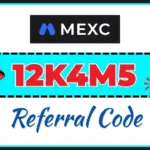
You can sign up for MEXC with or without a referral code, which links your new account to the person who shared it. Ours is 12K4M5: type it in the Referral Code field, or open MEXC sign-up with our link, which fills it in.
What a referral changes on MEXC:
- A possible Futures bonus for both sides. MEXC gives the referrer and the invitee a Futures bonus after a valid referral (MEXC Learn, checked 21 September 2026). To count, you deposit at least 100 USDT and trade over 500 USDT of futures, including leverage, within 7 days of sign-up (MEXC referral rules, July 2025). The amount isn’t published, the bonus can’t be withdrawn (only its profits), and countries that ban derivatives may be excluded. Don’t open a risky futures position just to earn it.
- No fee rebate and no VIP. 12K4M5 comes with no promised fee rebate. Invited users also can’t qualify for VIP, which needs 10,000,000 USDT of monthly volume (MEXC VIP program, March 2025).
- Welcome Gifts are separate. MEXC’s own new-user tasks pay up to 10,000 USDT in total as futures bonuses, copy trade bonuses and fee vouchers. A referral code doesn’t grant them (MEXC announcement, August 2025, checked 21 September 2026).
Enter the code before you finish sign-up. A main account (not a sub-account) can link a referrer within 30 days of sign-up, but can never change it later (MEXC linking guide, April 2026). The 7-day bonus window still counts from sign-up. Full rules: how the MEXC referral code works.
What to do next
- Check MEXC’s restricted-country list and your local rules before you open an account.
- Sign up in the official MEXC app or website. If you want to use our code, type 12K4M5 in the Referral Code field. Then complete KYC and turn on 2FA, an anti-phishing code and a withdrawal whitelist.
- Make a small test deposit on the right network. If you ever try futures, practice in demo trading first, because leverage can wipe out your margin.
More MEXC videos
A short answer from the same video series. The thumbnail opens the video on YouTube.

Frequently asked questions
What is MEXC exchange?
MEXC is a centralized crypto exchange founded in 2018. It offers spot trading, futures, copy trading, P2P, savings and on-chain trading for over 3,000 digital assets. It holds users’ coins in its own wallets. It doesn’t serve the US, the UK or Canada, and it has no EU MiCA license.
Is MEXC allowed in the US?
No. MEXC’s User Agreement says it doesn’t provide services to residents of the United States. The same applies to the UK, Canada, Mainland China, Hong Kong, Singapore and other places on its list. Don’t use a VPN or someone else’s documents to get around this.
Is MEXC a safe exchange?
It has real safety measures, but it isn’t regulated like a licensed EU exchange. MEXC publishes Proof of Reserves every month, and its Hacken-audited September 2026 report showed all four ratios above 100%. It also runs a Futures Insurance Fund and a Guardian Fund. It has no MiCA license, and its User Agreement caps its liability. Futures are high-risk.
What is the MEXC insurance fund?
It is MEXC’s Futures Insurance Fund. It pays the shortfall when a liquidated futures position loses more than its margin, so the account doesn’t go negative. MEXC reported 791.7 million USDT in it on 1 September 2026. It doesn’t give back the margin you lose at liquidation.
How do I get my money out of MEXC?
Complete KYC, move the coins to your Spot account, then withdraw to your own wallet or another exchange on the same network. Send a small test amount first. You can also sell for local currency on P2P, but release your crypto only after the payment has arrived.
Does MEXC require KYC?
Yes, to withdraw. Primary KYC (ID document) allows up to 80 BTC per 24 hours, and Advanced KYC (ID plus facial recognition) up to 200 BTC. Reviews usually finish within 24 hours. P2P, Earn and Launchpool also need KYC.
How much is 1 MEXC in US dollars?
MEXC is the exchange, not a coin. Its own token is MX, and its price changes all the time, so check the live MX/USDT market before you buy. We don’t quote prices, and MX fee perks can change, as the MX Holder Discount suspended in February 2026 shows.
Every MEXC rule and number in this guide comes from MEXC’s own pages, linked where it appears. Fees, KYC limits, Proof of Reserves ratios, the insurance fund balance and the account-restriction figure were re-checked on MEXC’s site on 21 September 2026.
Crypto prices move fast and you can lose money. This guide is for education, not financial advice. See our disclaimer.